
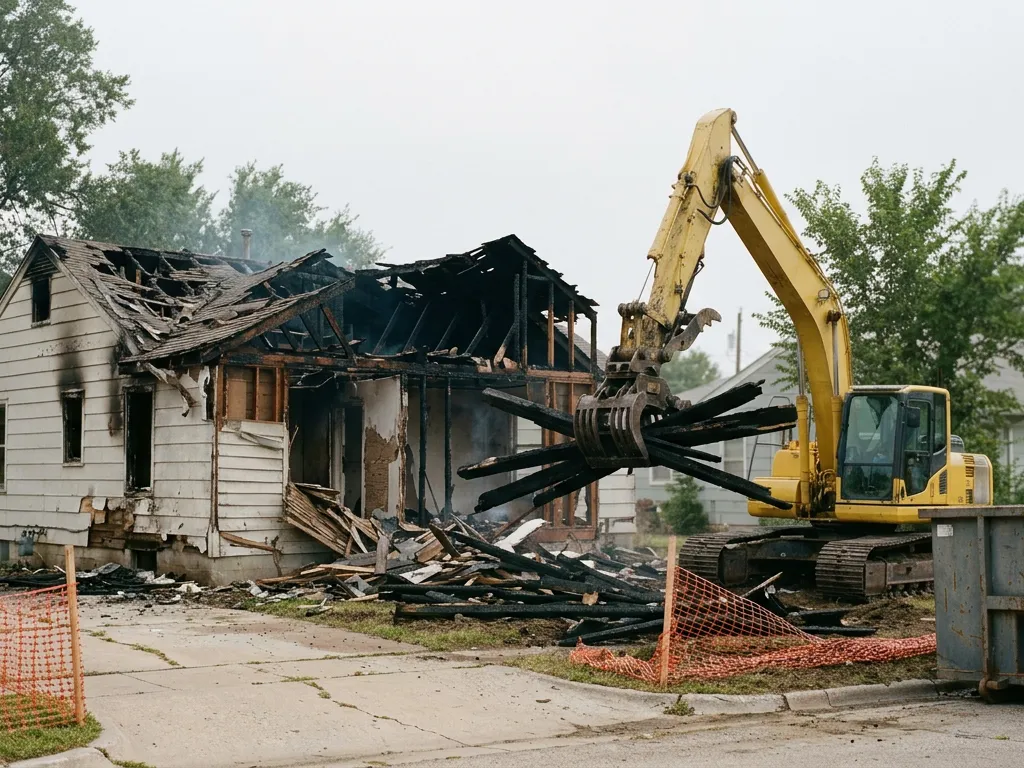
After a house fire
Topeka Demolition: Fire-Damaged House Demolition in Topeka, Kansas
Burned and smoke-gutted houses taken down once the insurer and investigators release them, with charred debris handled and the lot left safe.
- Topeka and 10 towns within 20 miles
- Written price before work starts
- Permit, sewer cap and landfill steps explained
- Local, licensed, insured contractors
Topeka Demolition connects Topeka owners and their insurance adjusters with local contractors for fire-damaged house demolition, the teardown that follows a fire when what is left is unsafe to enter and too damaged to rebuild from.
A burned-out house left standing can draw a nuisance order and still charge the owner for securing and insuring it; scheduling the $6,000 to $25,000 teardown as soon as the claim allows usually costs less than months of fencing, boarding and $100 to $500 code violations.
Typical price range
$6,000 to $25,000
The national range for house demolition (HomeAdvisor), which is where fire jobs land; the published Topeka range for an ordinary house is $9,500 to $20,100. Fire adds wet, heavy debris, possible asbestos in damaged materials, and sometimes hand work around a standing chimney or a shared wall.
Calls answered Monday to Friday 7 a.m. to 6 p.m., Saturday 8 a.m. to 2 p.m.
Signs the burned house cannot be saved
- Charred roof trusses, rafters or floor joists
- A partial or full roof collapse
- Walls out of plumb after the fire and the water used to fight it
- Smoke and soot through every room, including the framing
- An adjuster or engineer who calls it a total loss
Wait for the release, then move
Nothing comes down until the fire marshal and the insurance company are finished with the scene. Once they release it, the adjuster usually wants a written demolition estimate. A contractor can walk the site, photograph it and write a line-item estimate that an adjuster can compare against the policy's debris removal coverage.
What makes fire demolition different
Burned framing is unpredictable. It can drop without warning, so the excavator works from outside and nobody walks into the shell. Debris is heavier and wetter than a normal teardown and can carry ash and broken building materials that need testing. A chimney left standing after the fire is taken down early because it is the tallest thing on the lot and nothing braces it anymore.
- Asbestos testing on damaged siding, flooring and insulation before the bulk of the work
- Debris kept wet to hold down ash and dust for the neighbors
- Loads documented for the insurer with landfill receipts
After the teardown
Once the structure is gone, the foundation is removed or filled, the sewer stays capped, and the lot is graded. Many owners rebuild on the same ground; see teardown and rebuild for what the builder will want left. For houses outside the city, such as in Scranton or the rest of Osage County, the county or city office that issues permits there is the one to call.
Working with the adjuster
Most fire demolitions are paid at least partly by insurance, and the adjuster's file drives the schedule. A contractor can meet the adjuster at the site, walk the structure from outside, and provide a written estimate broken into demolition, debris removal, foundation work and grading. That breakdown matters because many policies list debris removal separately from the dwelling coverage.
Keep copies of everything: the estimate, photographs before and after, the permit, the sewer cap inspection and the landfill receipts. If a neighbor's house or fence was damaged by the fire or by the demolition, those records help sort out whose policy pays for what.
Questions people ask
How much does it cost to demolish a fire-damaged house?
Expect a range of $6,000 to $25,000, the national house demolition range, depending on size, basement, asbestos and how much hand work the damage requires.
Will insurance pay for demolition after a fire?
Many homeowner policies include debris removal, sometimes as a separate limit. The adjuster decides; a written contractor estimate helps the claim.
What are the signs a burned house is a total loss?
Charred structural framing, a collapsed roof, walls out of plumb, and smoke through the framing. An adjuster or engineer makes the call.
How soon after a fire can the house be torn down?
After the fire investigation and the insurance inspection release the scene. Until then, keep it fenced and boarded.
Is fire debris hazardous?
It can contain asbestos from older materials and ash, so testing comes first and the debris is kept wet during loading.
Get a demolition price in writing
Tell the contractor what is coming down, where it is, and what should be left behind: bare dirt, a slab, or a seeded lot.
Call (785) 268-2537