
Signs a house should come down
Topeka Demolition: Signs a House Should Be Demolished in Topeka, Kansas
Most houses can be repaired. These are the signs that say this one should not be, and the numbers that settle it.
- Topeka and 10 towns within 20 miles
- Written price before work starts
- Permit, sewer cap and landfill steps explained
- Local, licensed, insured contractors
Topeka Demolition hears the same question from owners in Topeka every week: is this house worth fixing, or should it come down? The honest answer starts with a short list of signs that point one way or the other, and ends with arithmetic.
The foundation signs
A house is only as good as what it stands on. In Topeka, many foundations sit in smectitic clay that swells in wet springs and shrinks in dry summers, and decades of that movement shows up in predictable ways.
- Block basement walls bowed inward, or cracked in a stair-step line through the mortar
- Horizontal cracks across a poured wall, which mean soil pressure is pushing it in
- Floors that slope enough that a marble rolls, and doors that will not stay shut
- A stone foundation with mortar washed out and stones loose or missing
Foundation repair is possible, and often worth it on a good house. On a small, older house with other problems, the repair alone can approach the cost of a new foundation under a new house.
The structure and roof signs
Rot that has reached the framing is the turning point. Siding, windows and drywall are surface work. Framing is the house.
- Rafters or trusses sagging, cracked or rotted from years of leaks
- Ceiling joists stained and soft under a long-failed roof
- Sill plates and the bottoms of wall studs rotted by water or termites
- Walls out of plumb, or a porch pulling away from the house
The damage signs
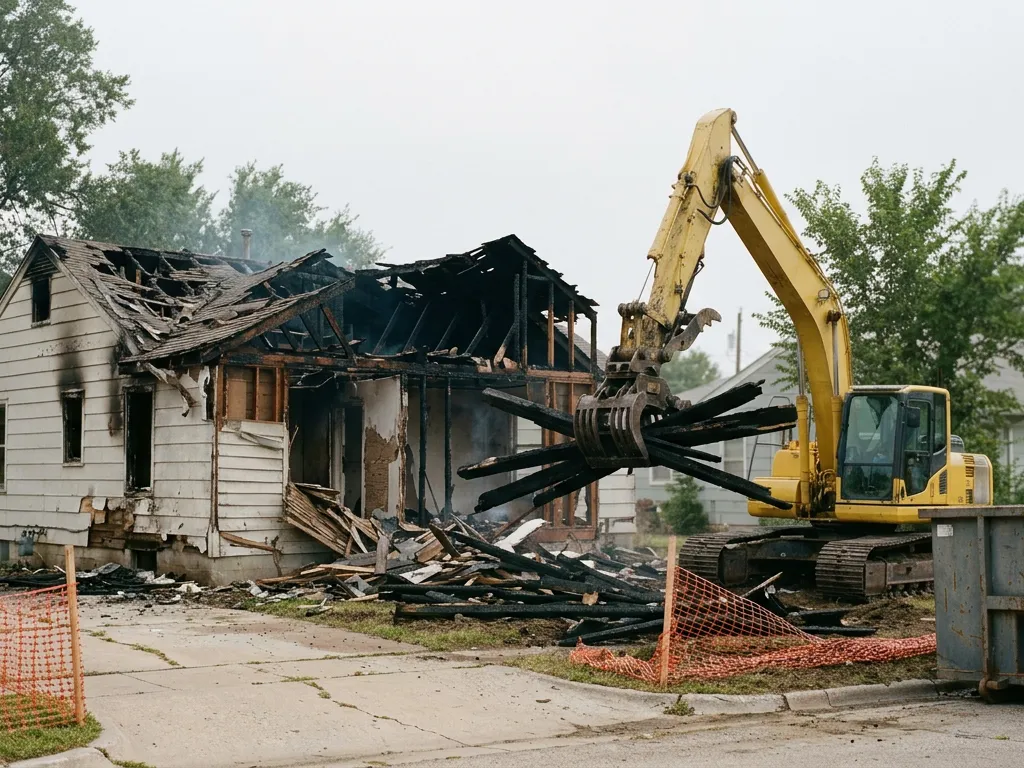
Fire, storms and long vacancy each leave their own marks. A fire that charred the roof structure or floor joists, a tornado or windstorm that tore the roof off and racked the walls, a tree through the floor framing, or years of vacancy with open windows and animals inside: each of those is a reason to get an adjuster's or engineer's opinion on whether the structure can be saved. Topeka knows how quickly this happens; the 1966 tornado destroyed about 820 homes in under an hour.
Calls answered Monday to Friday 7 a.m. to 6 p.m., Saturday 8 a.m. to 2 p.m.
The money signs
The decision is usually made with a calculator. Add the repair estimates: foundation, roof, framing, wiring, plumbing, windows, abatement. Compare the total with what the finished house would be worth, and with what a teardown and a new house would cost. When the repairs pass the finished value, or come close to the cost of building new, the house is a teardown in all but name.
Published Topeka figures put house demolition at $9,500 to $20,100. On a good lot, that plus a new house can be the better use of the money than a renovation that still leaves an old house.
The paperwork signs
Sometimes the City decides. Repeated code citations, a placard on the door, or a demolition order on a vacant house all set a clock running. The vacant house demolition page explains the City's Voluntary Demolition Program and how a private teardown fits around an order. Insurers also decide: an adjuster who calls a fire or storm loss total is the strongest sign there is.
What to do next
Get two opinions in one week if you can: a builder or inspector on the repair, and a demolition contractor on the teardown, so both numbers are in front of you. The house demolition page walks through what a teardown involves. If the house is outside the city, in a town such as Carbondale, the town page lists the office that issues permits.
Signs that look bad but usually are not
Not every alarming sight means a teardown. Hairline cracks in a poured basement wall, a few sticking doors after a dry summer, old paint peeling off siding, a roof that needs shingles but has sound decking, and a musty basement that dries out with a dehumidifier are all common in Topeka houses and all repairable. Clay soils move every year, so some movement is normal; the question is whether it is getting worse.
Before deciding, it helps to watch a crack over a season. Mark its ends with a pencil and the date. A crack that grows, widens or starts letting water in is a different story from one that has looked the same for years.
What a teardown buys you
Tearing down replaces unknowns with known costs. A renovation of an old house tends to grow as walls open and problems appear behind them. A demolition has a written price, a short schedule and a clear result: an empty, graded lot ready for a new house, a sale or a garden. For owners who inherited a house far from where they live, that certainty is often worth as much as the arithmetic.
Getting the decision right
Write down every repair estimate you have, the likely value of the house when repaired, and the cost of a teardown and a new house. Seeing the three numbers side by side usually makes the choice clear. If they are close, the deciding factors are often time, how long you plan to keep the property, and whether the location is worth more than the house that sits on it.
Houses that are worth saving
Some houses with scary problems are still good candidates for repair: a solid house in a good neighborhood with one failing wall, a sound frame under a bad roof, or a house whose only real problem is old wiring and plumbing. Older Topeka houses often have good framing lumber and solid layouts that are worth keeping. If an engineer says the structure is sound and the repair budget is well under the finished value, repair is usually the better path, and a demolition contractor can still help by removing a failed porch, garage or addition.
Questions people ask
What are the signs a house should be demolished?
A failing foundation, rot in the roof or wall framing, fire or storm damage to the structure, long vacancy damage, and repair costs above what the finished house would be worth.
Is a cracked foundation always a reason to demolish?
No. Many cracks are repairable. Bowing walls, horizontal cracks and a house with other major problems are when demolition becomes the better choice.
How do I decide between repairing and demolishing?
Add the repair estimates and compare them with the finished value and with the cost of tearing down and building new.
How much does demolition cost if I decide to tear it down?
Published Topeka figures run $9,500 to $20,100 for a house, depending on size, basement and asbestos.
Who can tell me if a house is structurally unsound?
A structural engineer, a home inspector, or an insurance adjuster after a loss. A demolition contractor can price the teardown side of the decision.
Can the City order a house demolished?
Yes, for dangerous or dilapidated structures. Acting before an order runs out lets the owner choose the contractor and timing.
Get a demolition price in writing
Tell the contractor what is coming down, where it is, and what should be left behind: bare dirt, a slab, or a seeded lot.
Call (785) 268-2537